The chestnut was
the first seed.
Goldberry Grove began in December 2024 when we — Abigail and Josh Dunbar — bought twenty acres above Summersville, West Virginia through the Ascend WV program. We came for two reasons: to be closer to family, and to plant a forest that would feed one.
— Josh and Abigail (and Quasar, the Samoyed)
Where the name comes from
Goldberry is a name borrowed from Tolkien — the River-daughter of the Old Forest. We took it because it sounded like a place rather than a brand, and because it carries the same reverence for the natural world that we wanted the farm to carry. The chestnut is the star, but the whole forest is the cast.
The chestnut, and why it matters
Abigail is Korean American, and chestnuts were a constant of her Korean home — roasted in the fall, steamed in winter, ground into porridge. When we moved to West Virginia, we learned the American Chestnut had once been the dominant tree of these forests before the blight wiped it out in the early twentieth century. Restoration efforts are still underway. The chestnut at Goldberry is our way of joining that work: a Korean-Appalachian bridge, planted as a quiet act of restoration.
We do not grow chestnuts for commercial sale of nursery stock. We grow them because the forest used to be full of them, and because they connect Abigail's family table to this land we now call home. The same is true of everything else we plant: it has to make sense in the long arc of an Appalachian forest, or it doesn't go in the ground.
An educational farm — not a nursery
We are sometimes asked if we sell seedlings. The honest answer is mostly no. Goldberry is an educational farm: we host mushroom-inoculation workshops, forest-farming seminars, foraging walks, JADAM and KNF intensives, u-pick weekends, and family events that put visitors on the land. The seven cleared acres of u-pick and the nine wooded acres of mushroom yard are the curriculum. The medicinal understory — ginseng, goldenseal, ramps, black cohosh — is the slow chapter we'll be teaching for the next decade.
What we believe about how to farm
We farm by JADAM and Korean Natural Farming principles — soil-led, microbe-led, no synthetic inputs, no shortcuts. The agroforestry design is syntropic: layered canopy, shrub line, herbaceous floor, mushroom logs in the woods. The goal is not maximum yield; it's a farm that gets healthier every year, that runs on biodiversity rather than fighting it, and that someone two generations from now can keep going.
Who's around when you visit
You'll usually meet at least one of us — Abigail or Josh — and almost always Quasar. On most weekends our farmhands George and Wesley are also on the land, running the rows, prepping for seminars, and keeping the mushroom yard honest. WWOOFers pass through in spring and fall; family events bring in our wider circle a few times a year. The farm is a small village, in the making.
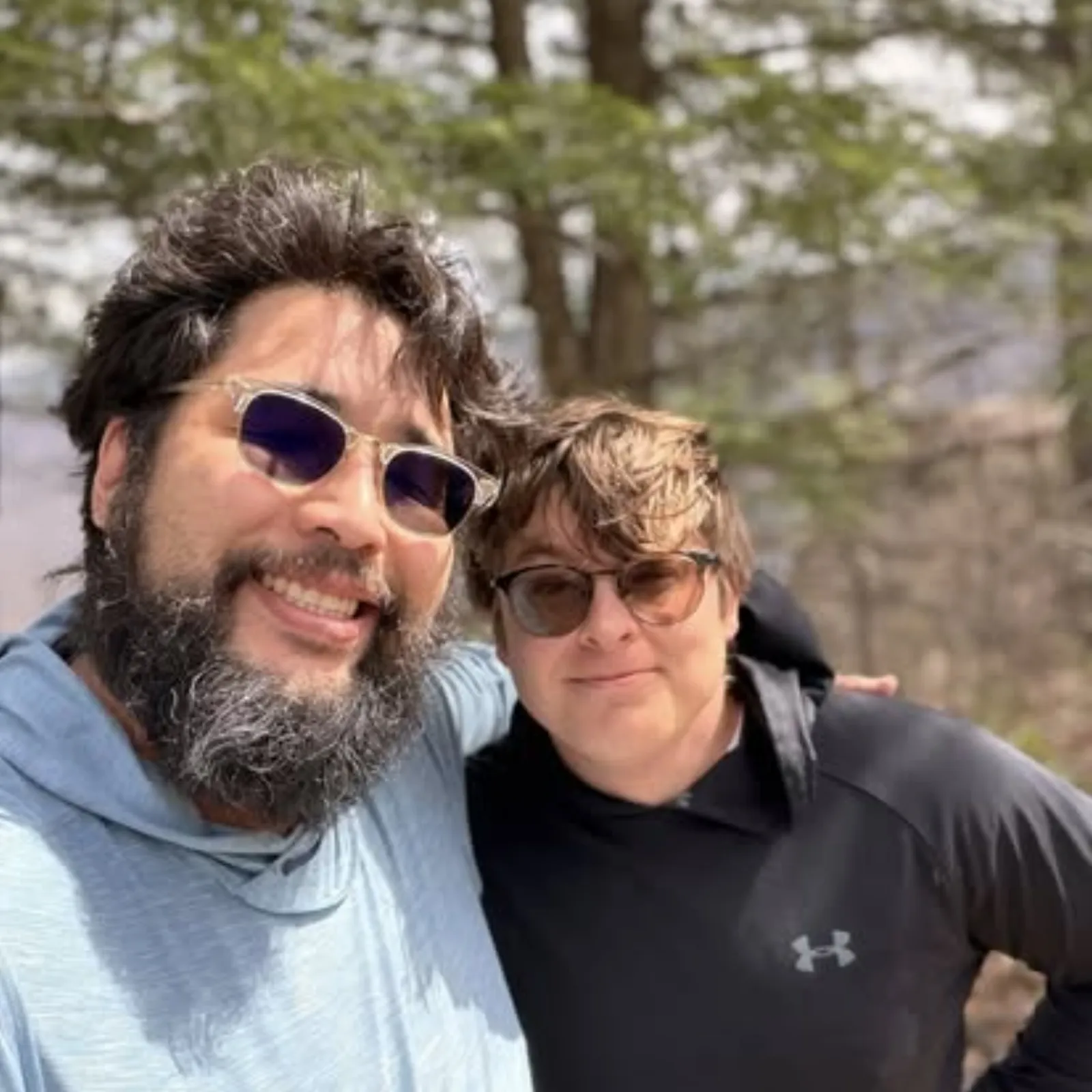
George & Wesley
keep the rows honest.
Goldberry's day-to-day runs on two farmhands. Wesley has been with the farm since 2025 — mushroom yard, inoculation workshops, and the kind of careful attention that the medicinal understory needs. George handles orchard care, the u-pick season prep, and most of the seminar logistics.
If you're at the farm for an event and we're behind on something, odds are good George or Wesley is the reason it's still on schedule.
Where we're headed
The plan thinks in decades. The chestnuts in year one are barely knee-high; they'll fruit in five to seven, and the canopy they form will define the farm twenty years from now. The mushroom yard fills in faster — a log lasts five years and pays for itself in two. The medicinal understory is the slowest layer — ginseng wants a seven-to-ten-year horizon before harvest.
We're a WWOOF host site, an ecovillage-in-the-making, and a farm built to welcome anyone learning to farm like a forest. If that sounds like your kind of place, the gate is open.
Come see us →